
Welcome to the definitive guide on understanding TOEFL levels. For anyone aspiring to study or work in an English-speaking environment, the TOEFL iBT test is a critical gateway. But a score on this exam is more than just a number—it’s a reflection of your ability to communicate effectively in an academic setting. This blog post will demystify the various TOEFL levels, breaking down what each score range means for your reading, listening, speaking, and writing skills. Whether you’re just starting your preparation or aiming for a top-tier university, grasping these proficiency levels is the first step toward achieving your goals. At Bolsa25 Academy, we specialize in guiding students from beginners to exam-ready, and this guide is part of our commitment to your success.
Purpose of Understanding TOEFL Levels
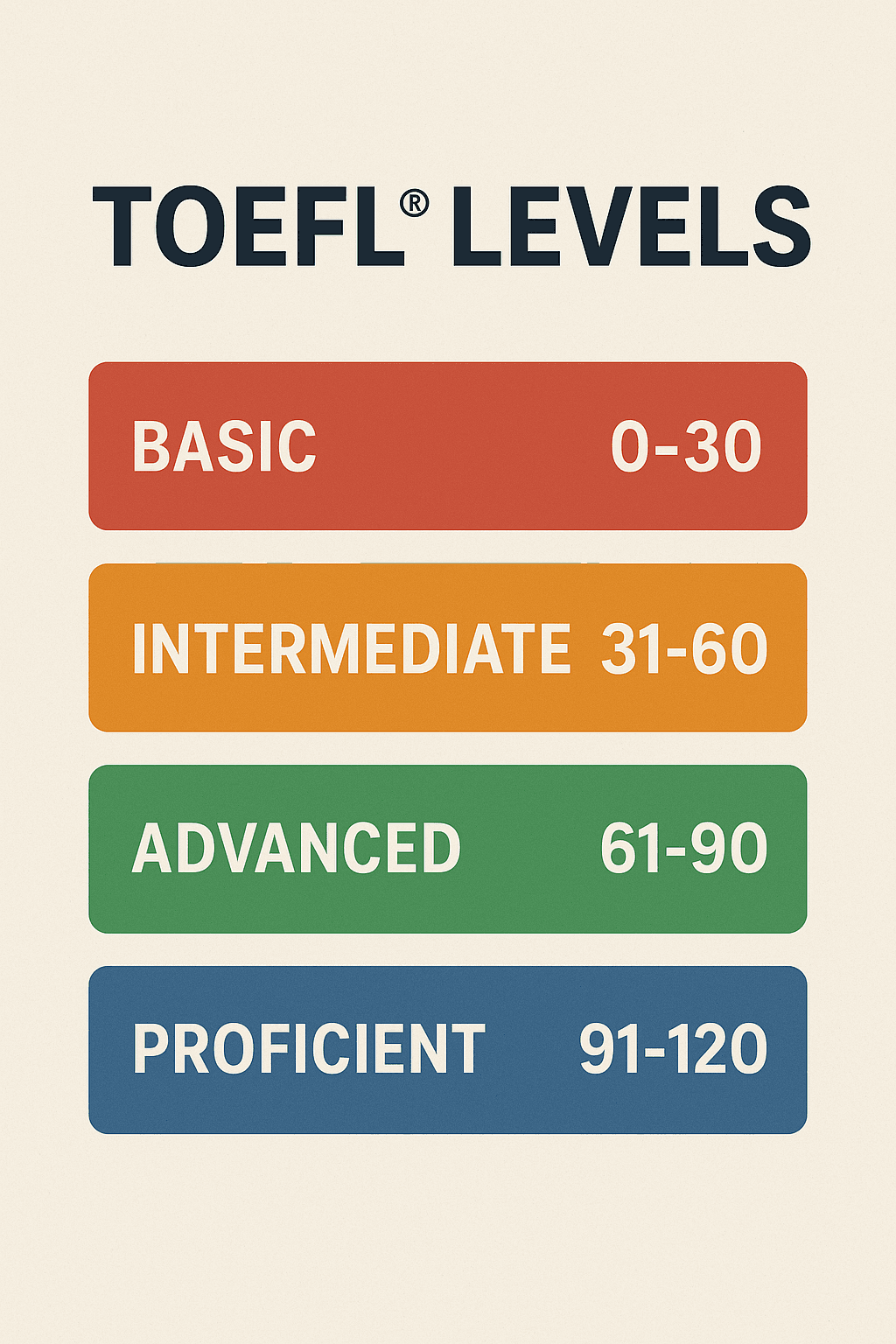
Why is it so important to look beyond the total score and understand the underlying TOEFL levels? The answer is simple: context and strategy. A TOEFL score report provides a detailed diagnostic of your linguistic abilities. Understanding your TOEFL level in each of the four skills—Reading, Listening, Speaking, and Writing—allows you to pinpoint your strengths and, more importantly, your weaknesses.
This detailed understanding serves several key purposes:
- Setting Realistic Goals: Knowing the specific requirements of your target universities helps you set a clear TOEFL level score to aim for. You can create a focused study plan tailored to bridge the gap between your current abilities and your desired outcome.
- Informing Your TOEFL Preparation: If your Reading score is at a ‘High-Intermediate’ level but your Speaking is ‘Low-Intermediate’, you know exactly where to allocate your study time. This targeted approach is far more effective than generic preparation.
- Demonstrating Readiness: For admissions officers, your TOEFL levels provide a nuanced picture of your academic readiness. A balanced score profile suggests you can handle all aspects of a demanding, English-medium curriculum, from reading dense textbooks to participating in class discussions.
Why Levels Matter for Academic and Career Paths?
Your proficiency, as defined by TOEFL levels, has a direct impact on your future opportunities. Both academic institutions and professional bodies use these levels as a benchmark to ensure you can thrive and contribute effectively.
Academic Admissions
Universities have specific minimum TOEFL requirements because they have correlated these scores with the linguistic demands of their courses. While the average minimum for U.S. universities is around 78 iBT, highly competitive institutions often require scores of 100 or higher. Some even set minimums for each section.
- Conditional Admission: If you meet a university’s academic criteria but your toefl level score is slightly below their requirement, you might be offered conditional admission. This often requires you to complete an intensive English program before starting your degree.
- Undergraduate vs. Graduate: Graduate programs, especially in fields like law, communications, and humanities, may have higher TOEFL requirements than undergraduate programs due to the advanced level of research and writing involved.
- Predicting Success: While not a perfect predictor, studies have shown a moderate correlation between higher TOEFL scores and higher first-year GPAs, particularly in technical fields. A score in the toefl advanced range indicates a strong readiness for academic challenges.
Professional and Career Opportunities
Beyond academia, many professional licensing bodies and employers require proof of English proficiency. A strong toefl level can be a prerequisite for:
- Licensing: Fields like engineering, nursing, pharmacy, and law in countries like the U.S., Canada, and Australia often require a specific TOEFL score for foreign-trained professionals to become licensed.
- Employment: Multinational corporations may use TOEFL scores to vet candidates for roles that require a high degree of English communication. A score of 80-100 is often seen as a standard for professional roles.
- Immigration: Some visa and immigration pathways, particularly for skilled workers, accept TOEFL scores as evidence of language ability.
What Are TOEFL Levels?
The TOEFL iBT test assesses your English proficiency across four sections, each scored from 0 to 30. These scores are then categorized into different proficiency levels, which describe the specific skills a test-taker at that level typically possesses. Understanding these descriptors is key to mastering the TOEFL level test.
Reading Section Levels
The Reading section measures your ability to understand academic texts.
- Advanced (Score: 24–30): You can understand dense, complex academic passages, including abstract ideas, difficult vocabulary, and sophisticated arguments. You can synthesize information from multiple parts of a text and infer an author’s purpose even when it’s not explicitly stated. This is the toefl advanced level.
- High-Intermediate (Score: 18–23): You can grasp the main ideas and important details of academic texts. You may struggle with parts that are conceptually dense or use low-frequency vocabulary.
- Low-Intermediate (Score: 4–17): You can understand some main ideas, especially when they are clearly presented and supported by examples. Your understanding is limited when faced with complex grammar and less common vocabulary.
- Below Low-Intermediate (Score: 0–3): Proficiency at the Low-Intermediate level has not yet been demonstrated.
Listening Section Levels
The Listening section assesses your ability to understand spoken English in academic contexts, like lectures and conversations.
- Advanced (Score: 22–30): You can understand conversations and lectures that include difficult vocabulary, complex ideas, and abstract concepts. You can follow intricate arguments and understand a speaker’s attitude or purpose from their intonation.
- High-Intermediate (Score: 17–21): You can understand the main ideas and key details in academic discussions. You might have difficulty if the information is very dense or not clearly reinforced.
- Low-Intermediate (Score: 9–16): You can understand the main points of a discussion, especially if the topic is familiar or ideas are repeated. You may miss details if they are not explicitly highlighted.
- Below Low-Intermediate (Score: 0–8): Proficiency at the Low-Intermediate level has not yet been demonstrated.
Speaking Section Levels
The Speaking section evaluates your ability to express your ideas clearly and coherently.
- Advanced (Score: 25–30): You can speak fluently and effectively on a range of academic and general topics. Your speech is clear, well-organized, and demonstrates a good command of grammar and vocabulary. Minor errors do not hinder communication. This is the toefl advanced level.
- High-Intermediate (Score: 20–24): You can communicate your ideas with reasonable clarity. You may have some noticeable pauses, and occasional errors in grammar or vocabulary might obscure meaning at times. Your responses are generally complete but may lack some development.
- Low-Intermediate (Score: 16–19): You can express simple ideas on familiar topics. Your speech may be slow, and your vocabulary and grammar are limited, which can make your responses difficult to understand at times.
- Basic (Score: 10–15): Your ability to express yourself is very limited. Responses are often incomplete, fragmented, and contain frequent errors.
- Below Basic (Score: 0–9): You have not demonstrated the ability to respond effectively.
Writing Section Levels
The Writing section measures your ability to write well-structured, well-supported academic essays.
- Advanced (Score: 24–30): You can write clear, well-organized, and well-developed essays on academic topics. You can effectively synthesize information from sources, present a strong argument, and use a wide range of vocabulary and complex grammatical structures with accuracy.
- High-Intermediate (Score: 17–23): You can address the topic and present relevant ideas. However, your essays may have some weaknesses in organization, development, or the use of grammar and vocabulary. You may have some difficulty synthesizing information from sources.
- Low-Intermediate (Score: 13–16): You can express some relevant ideas, but your writing shows significant weaknesses. Essays may be poorly organized, lack sufficient detail, and contain frequent errors in grammar and vocabulary that obscure meaning.
- Basic (Score: 7–12): You demonstrate a very limited ability to write on the topic. Your response may be off-topic, undeveloped, or largely incomprehensible due to severe language errors.
- Below Basic (Score: 0–6): You have not demonstrated even basic writing proficiency.
How Levels Reflect English Proficiency?
The TOEFL levels are more than just arbitrary bands; they are designed to reflect real-world communicative competence. The TOEFL iBT test uses integrated tasks—where you read, listen, and then speak or write in response—to simulate the language skills needed in a university classroom. This is how a toefl level test truly measures your ability to function in an academic environment.
For example, a high score in the Speaking section doesn’t just mean you have good pronunciation. It means you can synthesize information from a lecture and a reading passage, form a coherent opinion, and articulate it clearly under time pressure—exactly what you’d do in a seminar.
TOEFL Levels Compared to Other Exams
To better understand your toefl level, it’s helpful to see how it compares to other major English proficiency tests, namely IELTS and the Common European Framework of Reference for Languages (CEFR).
IELTS Band Score Comparison
While TOEFL and IELTS are different tests with different scoring systems, ETS has published research-based concordance tables to help compare scores. It’s important to remember that these are approximations, as the tests measure skills in slightly different ways.
Total Score Comparison
| TOEFL iBT Score (0–120) | Equivalent IELTS Band (0–9) |
| 120 | 9 |
| 115 | 8.5 |
| 108 | 8 |
| 100 | 7.5 |
| 91 | 7 |
| 81 | 6.5 |
| 67 | 6 |
| 51 | 5.5 |
| 37 | 5 |
| 26 | 4.5 |
| 14 | 4 |
CEFR Levels (A1–C2) Alignment
The Common European Framework of Reference for Languages (CEFR) is an international standard for describing language ability. It uses a six-point scale, from A1 for beginners up to C2 for those who have mastered a language. Aligning your TOEFL score with the CEFR can give you a globally understood measure of your proficiency.
TOEFL iBT Scores and CEFR Levels
| CEFR Level | TOEFL iBT Total Score (0–120) | Description |
| C2 (Mastery) | 114–120 | Can understand with ease virtually everything heard or read. Can summarize information from different sources, reconstructing arguments in a coherent presentation. Can express oneself spontaneously, very fluently, and precisely. |
| C1 (Advanced) | 95–113 | Can understand a wide range of demanding, longer texts, and recognize implicit meaning. Can use language flexibly and effectively for social, academic, and professional purposes. Can produce clear, well-structured, detailed text on complex subjects. |
| B2 (Upper Intermediate) | 72–94 | Can understand the main ideas of complex text on both concrete and abstract topics. Can interact with a degree of fluency and spontaneity that makes regular interaction with native speakers possible without strain. |
| B1 (Intermediate) | 42–71 | Can understand the main points of clear standard input on familiar matters. Can deal with most situations likely to arise whilst travelling. Can produce simple connected text on topics which are familiar or of personal interest. |
| A2 (Elementary) | n/a (Section scores apply) | Can understand sentences and frequently used expressions related to areas of most immediate relevance. Can communicate in simple and routine tasks requiring a simple and direct exchange of information. |
| A1 (Beginner) | n/a | Can understand and use familiar everyday expressions and very basic phrases. Can introduce him/herself and others and can ask and answer basic questions about personal details. |
Note: While there isn’t a total score mapping for A1/A2, specific low scores in the Speaking and Writing sections can correspond to these levels.
Minimum TOEFL Levels for Undergraduate Admissions
The “right” TOEFL score is the one that gets you into your desired university. Requirements vary significantly, so it’s crucial to research each school on your list. Here’s a general breakdown of what to expect:
- Highly Selective Universities (Ivy League, etc.): Typically require a total score of 100 or higher, often with minimum section scores of 25. This corresponds to a high C1 level.
- Competitive Public and Private Universities: Often look for scores in the 80–100 range. This places you solidly in the B2 to C1 range, demonstrating you are ready for academic work.
- Less Selective Universities and Colleges: May accept scores between 65–80. This B1 to B2 level might be sufficient for entry, sometimes with a requirement for supportive English classes.
- Conditional Admission Programs: Some universities offer pathways for students with scores below 65, requiring them to build their English skills before full matriculation.
Always check the official admissions website for each university, as requirements can change and may vary by department or program.
How Universities Interpret TOEFL Levels?
Admissions officers look at more than just your total score. They analyze your score report holistically to build a profile of your English abilities.
- Balanced vs. Spiky Profiles: A balanced profile, where all four section scores are relatively similar, is often preferred. It suggests consistent ability across all communication skills. A “spiky” profile—for example, very high Reading/Listening scores but low Speaking/Writing scores—can be a red flag. It might indicate that a student can understand lectures but will struggle to participate in discussions or write papers.
- Section Score Minimums: Many universities set minimums for each section for this very reason. A university might require a total score of 90, but also no less than 22 in Speaking, to ensure students can actively engage in the classroom.
- A Threshold, Not a Deciding Factor: For most universities, the TOEFL is a threshold requirement. Once you meet their minimum toefl level, your score becomes less important than other parts of your application, such as your essays, grades, and extracurricular activities. Scoring 115 instead of 105 at a school that requires 100 is unlikely to be the deciding factor in your admission.
Importance of Mock Tests and Consistent Practice
Understanding the theory behind TOEFL levels is one thing; achieving the score you need is another. The key to improving your TOEFL level is consistent, targeted practice and simulating the real TOEFL Test environment.
- Identify Your Baseline: Start with a full-length mock toefl level test to get a baseline score. This will immediately show you which of your skills are strongest and which need the most work.
- Simulate Test Conditions: Practice under timed conditions to build stamina and get used to the pressure. The TOEFL iBT is a long exam, and fatigue can affect performance.
- Analyze Your Mistakes: Don’t just check if your answer was right or wrong. Understand why it was wrong. Was it a vocabulary issue? A misunderstanding of the question? A grammatical error? This analysis is crucial for targeted improvement.
- Seek Expert Feedback: For the Speaking and Writing sections, self-study is not enough. You need feedback from an experienced instructor who understands the TOEFL rubrics. They can provide the specific, actionable advice needed to move from one proficiency level to the next.
In Conclusion
Navigating the world of TOEFL levels can seem complex, but it’s an essential part of your journey toward international education and career goals. By understanding that your score represents a specific set of skills, you can prepare more strategically, set achievable targets, and present a compelling profile to admissions committees. Remember that the TOEFL is a measure of your current ability, and with the right guidance and dedicated practice, you can significantly improve your toefl level.
At Bolsa25 Academy, we are committed to helping you succeed. Our courses are structured to build your core English skills and test-taking strategies, ensuring you are confident and prepared on exam day. Start your journey with us and turn your aspirations into achievements.
FAQs
Yes, a TOEFL score of 110 is generally considered to be at the C1 level according to the CEFR framework. TOEFL scores between 95-120 typically align with C1 proficiency, which represents advanced English language skills. A score of 110 demonstrates strong command of English across all four skills, with the ability to understand complex texts, express ideas fluently, and use English effectively for academic and professional purposes.
TOEFL scores in the range of 72-94 are generally equivalent to B2 level in the CEFR framework. This means students with scores in this range have good operational command of English, can understand complex texts on concrete and abstract topics, interact with native speakers with fluency, and produce detailed texts on various subjects. However, the exact equivalency can vary slightly depending on the specific conversion chart used by different institutions.
A TOEFL score of 72 is considered a decent score that places you at the B2 level. While it may be sufficient for some undergraduate programs and community colleges, it might not meet the requirements for competitive universities or graduate programs, which often require scores of 80-100 or higher. For students at Bolsa25 Academy, this score represents solid progress but indicates a need for further improvement to achieve the advanced proficiency levels required for top-tier academic institutions.
It’s essential to note that there are various TOEFL formats. If referring to the paper-based TOEFL, a score of 500 is considered below average and equivalent to approximately 61 on the internet-based TOEFL. This score typically indicates intermediate English proficiency and may not meet minimum requirements for most universities. Students with this score would benefit significantly from intensive English preparation, such as the conversation-focused courses offered at Bolsa25 Academy, to improve their TOEFL levels and achieve their academic goals.Is TOEFL 110 a C1?
Is TOEFL equivalent to B2?
Is 72 a good TOEFL score?
Is a TOEFL 500 a good score?